
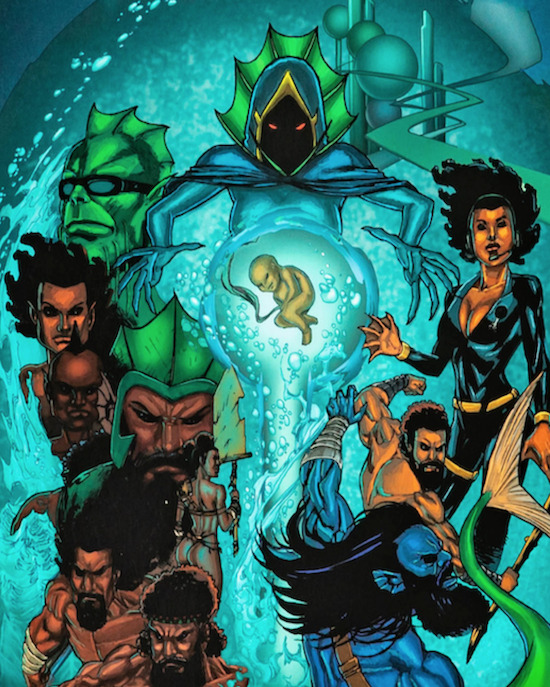
The Drexciyan Compendium: Book One, Mapping an Afrofuturist Oceanic Mythos
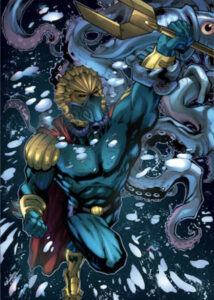
Courtesy AbuQadim Haqq
The Drexciyan Compendium: Book One is a deep, immersive graphic novel chronicle of one of the most enduring and imaginative mythologies in electronic music culture. Created by AbuQadim Haqq (formerly known as Abdul Quadim Haqq), founder of Third Earth Visual Arts, the book brings together Afrofuturism, aquatic mythology, and techno mysticism into a single, unified narrative that fully articulates the world of Drexciya, a world that had previously been revealed primarily through sound.
Set within an imagined oceanic realm born from the fall of Atlantis and shaped by black imagination, the Compendium unfolds as a mythic archive. Told through brilliantly illustrated storytelling, symbolic “scrolls,” and vivid illustrations, Book One traces the origins of a sovereign underwater civilization forged by sorceresses, warriors, scientists, and rebels. These figures carry the memory of displacement while embodying survival, innovation, and resurgence.
At the heart of the narrative are foundational characters such as Drexaha the Eternal Tidebearer, Doctor Blowfin, whose work sparks a scientific revolution, the Mothers of the Abyss, and the first great Drexciyan clans. Together, their stories form a cosmology rooted in resistance and futurity—echoing both the horrors of history and the possibility of liberation through imagination and technology.
From Detroit to the Deep Sea
While the story itself exists in a mythic Atlantic world, often described as somewhere between Atlantis, Africa, and an imagined “free land,” the cultural origin of Drexciya is firmly terrestrial. Drexciya was conceived in Detroit, the birthplace of the legendary techno duo Drexciya: James Stinson and Gerald Donald. Through a series of albums, they introduced fragments of a submerged civilization, allowing listeners to feel the world through rhythm, texture, and narrative suggestion rather than linear storytelling.
Haqq was present at the very beginning of this process, literally at the kitchen table—helping visualize the universe that Stinson and Donald were building sonically. Over decades, he has worked to extend and clarify those ideas, translating the mythology embedded in the music into a fully realized visual and narrative form. The Drexciyan Compendium represents the most complete articulation of that effort to date.
A Complete Archive of the Drexciya Story
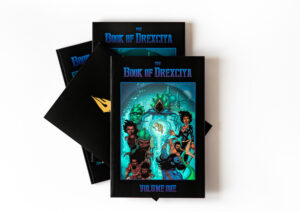 Importantly, The Drexciyan Compendium: Book One is not an isolated project. Haqq previously collaborated on The Book of Drexciya Volumes 1 and 2, published by Tresor, which expanded the mythos into graphic-novel form. The Compendium goes further—bringing together the full narrative of Volumes 1 and 2 while adding new depth, context, and continuity. It is the definitive version of the Drexciya story, told in full by the artist who helped shape its visual language from the start.
For longtime followers of the Drexciya mythos, the Compendium reads like a long-awaited sacred text. For newcomers, it functions as a clear entry point into a universe where electronic music, speculative history, and Afrofuturist philosophy converge. In this video, Haqq interviews the mother of James Stinson about his childhood.
A Living Mythology
Ultimately, The Drexciyan Compendium: Book One is more than a book. It is an archive of memory, a speculative history, and a continuation of a cultural movement that began in Detroit basements and record bins and expanded into a global Afrofuturist myth. Whether approached as lore, art, or cultural history, it captures Drexciya as it was always meant to be experienced: deep, immersive, and endlessly resonant.
Hearing the Myth: “The Quest” in Motion
These two embedded video clips from The Quest offer more than a listening experience — they provide an entry point into the sonic architecture of Drexciya’s underwater world. Released in 1997 by Submerge as both a double-vinyl and CD compilation, The Quest marked a pivotal moment for the duo. It gathered key tracks from earlier EPs and added new material, making their once-elusive music widely accessible for the first time.
For many fans, this was a spiritual moment: Drexciya’s submerged transmissions were finally available in one cohesive body of work. The sleeve notes, attributed to “The Unknown Writer” and widely believed to be Underground Resistance’s Cornelius Harris, crystallized the mythology that had previously been implied through sound alone. They introduced the now-famous narrative of a Black Atlantis: the possibility that pregnant African women thrown overboard during the transatlantic slave trade gave birth to children who adapted to breathe underwater. With this revelation, the Drexciya legend sharpened into focus. The music was no longer simply futuristic electro; it was a speculative history, a counter-memory, and a work of Afrofuturist resistance that gave birth to the mythos of The Drexciyan Compendium.
Sonically, The Quest remains the strongest Drexciya release. Its aqueous electro glide, the ice-water snap of the Roland 808 paired with tough, melodic synth lines, evokes an underwater voyage in a futuristic submarine. Tracks like “Antivapor Waves,” “Bubble Metropolis,” and “Depressurization” feel cinematic in scope. British-Ghanaian theorist Kodwo Eshun described how the duo imagined themselves in a submersible at the bottom of the ocean before making music, metal creaking under pressure, darkness pierced by sweeping searchlights. You can hear that tension between darkness and illumination in every measure. The music itself becomes a portal to the mythic undersea world.
Why World-Building in Music Matters

Courtesy AbuQadim Haqq
World-building in music is powerful because it expands sound into narrative space. It invites listeners not just to hear rhythms but to inhabit environments. In the case of Drexciya, the mythology transformed electro into something larger than genre; it became a speculative archive of memory, trauma, survival, and afrofuturism. The world gives context to the sound; the sound animates the world. Together, they create immersion.
AbuQadim Haqq’s illustration for Mike Banks’ The Analog Assassin captures the militant futurism at the core of Detroit techno’s Underground Resistance movement. Asked to create a “ninja-type character,” Haqq responded not with a traditional martial figure, but with a sonic warrior, a stealth operative armed not with blades, but with sound. Inspired directly by the percussive intensity of the music, Haqq imagined a fighter who wields analog frequencies as weapons: sonic guns, vibration-based artillery, and acoustic force as strategy. The result is more than cover art; it is a visual manifesto. The Analog Assassin becomes a symbol of resistance through sound, embodying the idea that music itself can be a stealthy tactical force, precise, disciplined, and revolutionary.
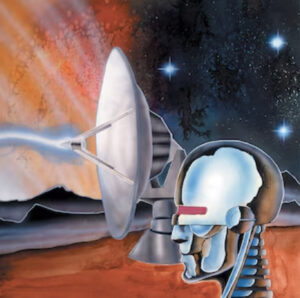
Courtesy AbuQadim Haqq
This is why collaborations between visionary visual artists and musicians are so vital. AbuQadim Haqq did not simply “illustrate” Detroit techno — he helped define its visual cosmology. His work for Juan Atkins’ Model 500 projects gave electro a sleek, futuristic cyberpunk visual identity that matched its sonic ambition.
 Likewise, his illustrations for Carl Craig’s E2000 releases extended techno’s relationship with science fiction and time travel into graphic form. These images were not marketing add-ons; they were cybernetic tools for world-building. They reinforced the idea that Detroit techno was not just club music but speculative philosophy set to rhythm.
In this way, the partnership between Haqq and Detroit’s techno pioneers represents a broader creative principle: when sound and image collaborate with shared conceptual intent, culture deepens. The myth becomes tangible. The record sleeve and vinyl label become artifacts, part of a cryptic cypher that must be collected and assembled to unlock a broader mythos from the past. The music becomes scaffolding to create the narrative architecture of future worlds. And for Black artists especially, world-building becomes an act of reclamation — constructing futures on their own terms while reframing histories of trauma through imagination.
Here’s an interesting video exploration of Drexciya’s mythology and Afrofuturism created by Resident Advisor. It delves into the Jazz of Sun Ra, the Funk of George Clinton and futurist artists like Jeff Mills, contextualizing Afrofuturism in music.
AbuQadim Haqq and Black History Month
Within the context of Black History Month, Haqq’s role in Afrofuturism takes on particular significance. His work exemplifies how Black creators have used speculative futures to reclaim history, address displacement, and imagine sovereignty beyond imposed boundaries. By translating the Drexciya narrative into a complete visual and literary form, Haqq preserves an essential chapter of Black electronic music history while expanding it into a broader cultural mythology.
His career, spanning album artwork for Detroit techno pioneers such as Juan Atkins, Derrick May, Kevin Saunderson, Underground Resistance, and Carl Craig, and his founding of Third Earth Visual Arts, to take his work into art galleries around the world, demonstrates how visual art, music, and futurist thinking have long been intertwined in Black creative movements. The Drexciyan Compendium stands as both an artistic achievement and a historical document, affirming the power of Black imagination to build worlds that are as intellectually rigorous as they are visionary.
Learn more and purchase the book here: The Drexciyan Compendium: Book One
Resources
- Red Bull Music Academy – Abdul Qadim Haqq Feature
- DJ Mag- How Drexciya’s The Quest Embedded Detroit Act’s Mythology into Dance Music History
- Red Bull Music Academy- The Art of Drexciya
Special thanks to Anita Wilhelm for her role in collaborating on this article and for her role in compiling the compendium with Haqq.
